Showing posts with label Grammar. Show all posts

Saturday, January 6, 2018

Been vs Being

Being is present participle, whereas been is past participle

Been can be applied to more tenses compared to being.

As a rule, the word been is always used after have (in any form, e.g., has, had, will have). The word being is never used after have. Being is used after to be (in any form, e.g., is, was, were).

Friday, September 1, 2017

The difference between USED TO and WOULD

Used to and would are both use to describe something that happened regularly in the past but doesn't happen any longer, as shown in the following two sentences about quitting smoking:

I used to smoke, but I quit last year.
Whenever I craved a cigarette, I would chew gum instead.

However, there are two important differences between used to and would. The first difference is that would should not be used unless it has already been established that the time frame is in the past, while used to does not require this. This example, with used to at the beginning, sounds natural:
I used to watch cartoons every Saturday morning when I was very little. Now I rarely watch TV.

However, when used to is replaced with would, the same example becomes awkward and ungrammatical: 

*I would watch cartoons every Saturday morning when I was very little. Now I rarely watch TV.

But if the past time frame is established before would appears, would sounds fineƑ

When I was little, I would get up and watch cartoons every Saturday morning. Now I rarely watch TV.
The second difference between used to and would is that would is not used with stative verbs such as love, be, understand, and feel. Compare these two sentences with the stative verb love: 
 
When I was a student, I used to love sleeping late on the weekends. (natural and grammatical)
*When I was a student, I would love sleeping late on weekends. (awkward and ungrammatical)

To summarize, the use of would is more restricted than that of used to. Therefore, if you aren't sure which one to use, it's best to choose used to.

Taken from:
http://www.learnersdictionary.com/qa/the-difference-between-used-to-and-would

Sunday, March 27, 2016

Expresing Purpose; Reason/Cause; Result/Effect

PURPOSE:


Examples:
We had a meeting today so as to discuss next year's programme.
He did all he could for her not to worry.
I moved to France so that I could improve my French.
Everyone did their best in order to finish the work.


REASON:
 
Examples:
Since you don't believe me, I won't give evidence.
Because of his lack of training he had difficulties finding a job.
He gave him his jacket out of pity.
On account of the weather we didn't go for a walk.
Billy was punished for lying to his teacher.
Owing to the snow,the planes couldn't take off.
As you are a foreigner you can't express your opinions on the situation in the area.
Seeing that you aren't interested I' ll do it by myself.

RESULT:
Examples:
He missed the early train, as a result he was too late for the job interview.
The result of his trial, therefore, could hardly have been other than a foregone conclusion.
If he locked the door, then Kitty is trapped inside.

taken from:
http://languagelearningbase.com/19645/expressing-purpose-reason-cause-result-effect

Thursday, March 24, 2016

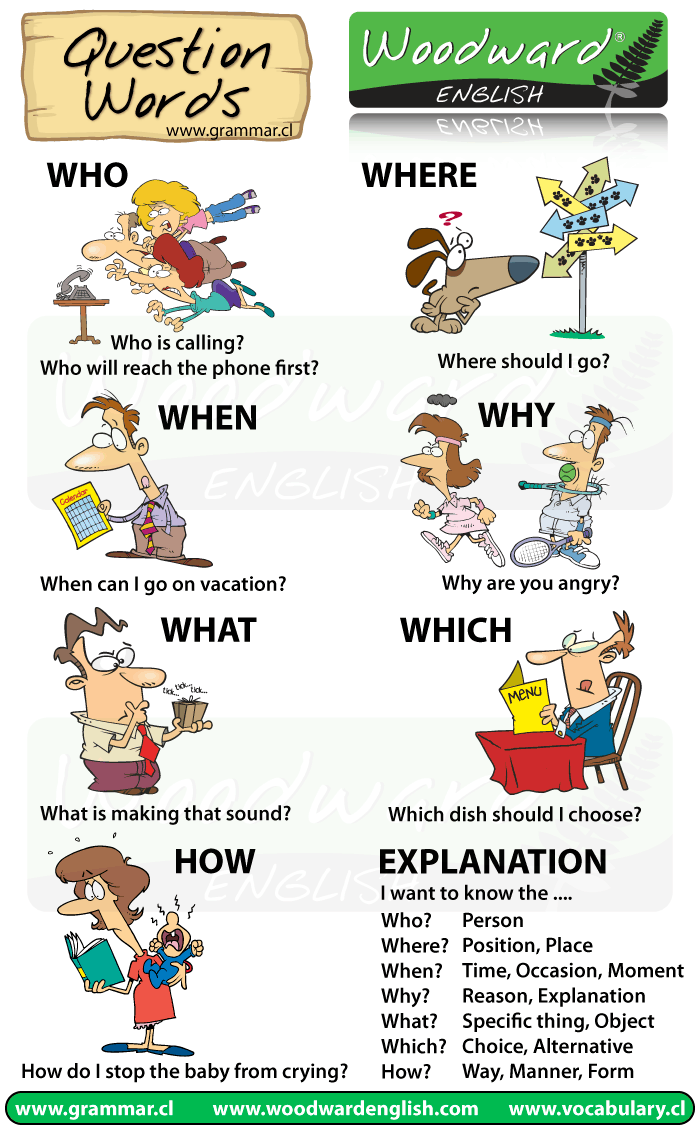
Question Words

A chart with Question Words in English using cartoons to help explain them.


There are two types of questions in English.
1. Yes/No questions use the auxiliary verb To Be or To Do and can be answered by a simple Yes/No and the auxiliary.
Example:
A: Are you a student?
B: Yes, I am/ No, I'm not
A; Is he your brother?
B: Yes, he is/ No, he isn't

A: Do you like your new teacher?
B: Yes, I do/No, I don't
A: Does she likes pizza?
B: Yes, she does?No, she doesn't

2. Wh-questions are those that ask for complete information and use question words (Wh words) at the beginning of the question plus the auxiliary verb To Be or To Do or To Have (perfect tenses)
Example;
A: Where are you from?
B: I'm from the United States/ I'm American
A: What does your father do? = What does your father do for a living?
B: He is a teacher.
A: Why isn't she coming to class today?
B: Because she feels sick.
A; What have you been doing lately? (present perfect continuous)
B: I have been studying for my exams (present perfect continuous)

Tuesday, March 22, 2016

Can/Cannot (Can't)

Can is a modal verb.

Can is used to express ability or to say that something is possible.

Can is the same for all subjects. We don't add an 'S' in the third person (like other verbs)

The verb that comes after Can is in the infinitive without to:
I can speak Spanish. (= it is possible for me to speak Spanish = I have the ability to speak Spanish)
He can swim well.
We can see our neighbour in the garden.
They can play the guitar.


Negative

To form the negative we add "not" after can to form one word: cannot.
We can also contract the negative to form can't. (can't = cannot)
I cannot play the piano. We can't go to the cinema tonight.
She cannot speak French very well. He can't drive a car.


Questions
To from the question we change the position of the subject and the auxiliary verb.
The main verb is still in the infinitive without to.
Where can I buy an ice-cream?
Can I go to the party, please?
Can you speak Japanese?
What can we do on Saturday?


Remember that you can use short answers:
Can I sit here please? Yes, you can.
Can you speak Chinese? No, I can't.


Impersonal Can
Sometimes You can and Can you…? are impersonal and refer to people in general.
You can see many stars at night from here. (= people in general can see many stars)
It doesn't necessarily refer to you but people in general.
You can't run naked in the middle of the street.
Not necessarily saying YOU can't run naked in the middle of the street but in general it is not possible for anyone.

taken from:

All - Every - Each,

All means the total number of people or things considered as a group.
Every means all members of a group considered individually.
Each means all members of a group considered individually though we think of them more one by one.

What is the difference between Each and Every?
Both Each and Every generally have the same meaning. They refer to all members of a group considered individually. Every is closer in meaning to All than Each is.

Every book in the course must be read before the end of the semester.
Each book in the course must be read before the end of the semester.

(= This book and that book and that book etc. of the group of books) We use each when we think of them more as one by one. There is a little less emphasis on the individual with Every when comparing it to Each.

However notice that every cannot be used when referring to two things and is not common with small numbers.
Every (one) of my parents (incorrect)
Each of my parents (correct)

We cannot use Each with the words Almost or Nearly. Here we use Every.
Almost each car pollutes the atmosphere. (incorrect)
Almost every car pollutes the atmosphere. (correct)

More details about Every, Each and All…
-- EVERY --
Every refers to all members of a group though considered individually. It can be used to talk about three or more people/things.

Every + singular noun
The noun that comes after Every is in singular form.
I have visited every country in South America (we do NOT say: every countries)
I can understand every word our teacher says. (we do NOT say: every words)

Note, when you use every + noun as a subject, it uses a singular verb (verb + s)
Every day is a chance to learn something new.
Every child needs love and care.
Every house on the street looks the same.
Every + number + plural noun
Every can be followed by a plural noun when there is a number before that noun. This is common with periods of time or things at regular intervals.
He gets his head shaved every three weeks.
You need to take a break every two hours.


We can also use every without a number and a singular noun to refer to regular intervals:
He plays football every Saturday.
She goes to the gym every day.


-- EACH --
Each refers to all members of a group though we think of them more one by one (individually). Each can be used to talk about two or more people/things.
Each + singular countable noun
You use a singular (countable) noun after the word Each.
Make sure you enjoy each moment in your life.
They play the national anthem of each country before the game begins.
Live each day as if it were your last.

Each + one
One can be used to replace the singular countable noun if it has already been mentioned.
A: What do I have to do with these antique vases? B: You need to take each one out of the box very carefully. (each one = each vase)
Each of + determiner + plural noun
Each can be followed by a determiner (my, his, the, etc.) and a plural noun.
I kiss each of my children before they go to bed at night.
The teacher had a little kid holding on to each of her hands.
Each of the guides has a different group to show around the museum.


Notice how after each of the verb is usually in singular form though when speaking informally, you will sometimes hear a plural verb used.
Each of my students has a different assignment to complete. (correct use)
Each of my students have a different assignment to complete. (informal use)
Each of + pronoun (you/us/them)
We can only use the pronouns you/us/them after each of.
He gave each of us a small gift at the end of the course.
You need to wash each of them before use.
Each of you needs to complete the assignment individually.

Again the verb following each of + pronoun should be in the singular form.
Each as a pronoun
Each can be used by itself (without a noun) as a pronoun.
When the students finished to course, each was given a certificate. (Each = each of the students)

Though it is more common to use each one instead of each by itself.
…each one was given a certificate.
Noun/Pronoun + each
Each can be used after the noun (or pronoun) it describes.
The parents gave their children some pocket money. To avoid problems, they each received the same amount.
Auxiliary Verb/To Be + each
Each can be used after an auxiliary verb or the verbs Are and Were.
I have four books to sell and they are each worth around five dollars.
They have each been told their responsibilities.

Object + each
Instead of going before/after the subject, each can appear after the object.
This is common when the noun object refers to an amount, how many of something there is or when giving a price.
My paintings are worth $100 each (= Each of my paintings are worth $100)

-- ALL --
All refers to the total number of people or things of a group. They are considered as a group and not individually. There are minimum three things in the group.
All + noun
We can use All with a plural noun to make a generalization about an entire group of something.
All sharks are dangerous.
All elephants are slow.

All + of + determiner + noun
The noun can be singular, plural or an uncountable noun. These nouns can also be replaced by pronouns.
You need to read all of the book.
All of the pages are yellow and old.
All of the fish in the pond have died.
You need to remove all of them before they start to smell bad
.

Note that All of + singular noun is not common and Whole or Entire used instead of all of.
You need to read the whole book (= all of the book)

We can also remove OF before the determiner + noun (but we must use OF before a pronoun)
You need to read all the book.
All the pages are yellow and old.
All of the fish in the pond have died.
You need to remove all of them before they start to smell bad.

Pronoun + all
Sometimes you can place All after a pronoun to emphasize that every single one of that group is included.
We all hope you get better soon.
I hope you all have a great time.
I have made us all some sandwiches.

Compare All vs. Each
All refers to the entire group as a whole. Each refers to the individual members of the group.
I say goodbye to each student as they leave the room.
(= Goodbye John, goodbye Mary, goodbye Daniel… etc. until it has been said to ALL of the students individually… Yes, there is a lot of repetition)

I say goodbye to all of the students as they leave the room.
(= Goodbye students … I just say goodbye once)
Compare All vs. Every
A simple way to remember is that All is with a plural noun + plural verb while Every is with a singular noun +singular verb. Every can also suggest “without exception”.
All students receive a certificate.
Every student receives a certificate.


We can use All with uncountable nouns (and not Every).
I like all music (NOT every music)
Place all luggage on the counter. (NOT every luggage)

taken from:

Sunday, March 13, 2016

Who vs. Whom


Reported Speech

Reported speech is how we represent the speech of other people or what we ourselves say.
Direct speech repeats the exact words the person used, or how we remember their words:

Ex: Barbara said, “I didn’t realise it was midnight.”

In indirect speech (Reported Speech, the original speaker’s words are changed.

Ex: Barbara said she hadn’t realised it was midnight.
If you have a sentence in Direct Speech, try to follow our 5 steps to put the sentence into Reported Speech:
1. Define the type of the sentence (statement, questions, command)
2. What tense is used in the introductory sentence?
3. Do you have to change the person (pronoun)?
4. Do you have to backshift the tenses?
5. Do you have to change expressions of time and place?

Verb tense change (backshift) when using Reported Speech:


Reporting verbs:

We can use say and tell to report statements in direct speech.

Other reporting verbs:
add, admit, advise, agree, announce, answer, ask, claim, comment, complain, confess, confirm, continue, cry (=shout), demand, enquire, explain, hint, inform, insist, interrupt, maintain, note, observe, offer, order, point out, promise, protest, repeat, reply, shout, state, suggest, threaten, warn, 
wonder.

Ex.: Direct Speech:  Peter: "I made a mistake". 
       Reported Speech:  Peter admitted (that) he had made a mistake.
       Direct Speech: Mary: "I am going to get married this year. 
       Reported Speech: Mary announce to all her friends (that) she was going to get married that year

Conversion of expressions of time and place:

If there is an expression of time/place in the sentence, it may be changed, depending on the situation.
Direct Speech → Peter: “I worked in the garden yesterday.”
Reported Speech → Peter said (that) he had worked in the garden the day before.


taken from: