
Sunday, June 14, 2015

Saturday, June 13, 2015
Stative Passive
Stative passives are verb-like words that follow "be" in sentences and function as adjectives. See the examples below:
He is hungry. (adjective)
He is interested (stative passive)
His leg is broken (stative passive)
Stative passives indicate a status or condition which may exist over a period of time. In contrast, action verbs often indicate a change from one status to another.
We got married in 1998. (Action: We changed from "single" to "married.")
We are married now. (Status: Our current condition is "married.")
Jack broke the window. (Action: Indicates what happened at a given moment.)
The window is broken. (Status: Indicates the condition of the window.)
Note how the action/status contrast works with other verbs:
Jared fell asleep. (Action: Change in status from "awake" to "asleep").
Jared is asleep. (Status: Indicates Jared's current condition.)
Stative passives are often used with prepositional expressions.
She is interested in photography.
Brad was worried about his mother.
Carmen is terrified of snakes.
Everyone was caught up in the excitement.
Stative Passive Constuctions Describing Emotional States
A salient type of stative passive is the combination of the verb to be with adjectives that describe an emotional state. There are about three dozen of them in common use. They are derived from verbs and are identical in form to past participles, most of them ending in -ed. But instead of indicating an action, they refer to the experiencing of an emotion. Note these examples:
I was bored. (= I felt bored.)
I was depressed. (= I felt depressed.)
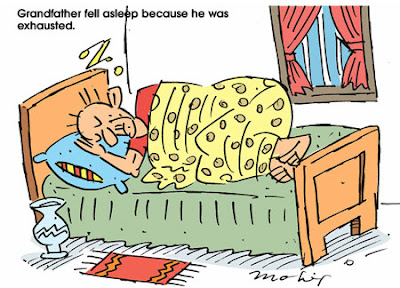
I was exhausted. (= I felt exhausted.)
He is hungry. (adjective)
He is interested (stative passive)
His leg is broken (stative passive)
Stative passives indicate a status or condition which may exist over a period of time. In contrast, action verbs often indicate a change from one status to another.
We got married in 1998. (Action: We changed from "single" to "married.")
We are married now. (Status: Our current condition is "married.")
Jack broke the window. (Action: Indicates what happened at a given moment.)
The window is broken. (Status: Indicates the condition of the window.)
Note how the action/status contrast works with other verbs:
Jared fell asleep. (Action: Change in status from "awake" to "asleep").
Jared is asleep. (Status: Indicates Jared's current condition.)
She is interested in photography.
Brad was worried about his mother.
Carmen is terrified of snakes.
Everyone was caught up in the excitement.
A salient type of stative passive is the combination of the verb to be with adjectives that describe an emotional state. There are about three dozen of them in common use. They are derived from verbs and are identical in form to past participles, most of them ending in -ed. But instead of indicating an action, they refer to the experiencing of an emotion. Note these examples:
I was bored. (= I felt bored.)
I was depressed. (= I felt depressed.)
I was exhausted. (= I felt exhausted.)
Instead of an agent by-phrase, these adjectives most often take a range of prepositions to connect them to the cause of the emotion.
I was exhausted from so much work.
I was interested in computers.
I was bored with my classes.

I was exhausted from so much work.
I was interested in computers.
I was bored with my classes.

Taken from:
Friday, June 12, 2015
Quantifiers
We use quantifiers when we want to give someone information about the number of something: how much or how many.
Sometimes we use a quantifier in the place of a determiner:
Most children start school at the age of five.
We ate some bread and butter.
We saw lots of birds.
We use these quantifiers with both count and uncount nouns:
all, any, enough, less, a lot of, lots of, more, most, no, none of, some
and some more colloquial forms:
plenty of, heaps of, a load of, loads of, tons of, etc.
Some quantifiers can be used only with count nouns:
both, each, either, (a) few, fewer, neither, several
and some more colloquial forms:
a couple of, hundreds of, thousands of, etc.
Some quantifiers can be used only with uncount nouns:
a little, (not) much, a bit of
And, particularly with abstract nouns such as time, money, trouble, etc:, we often use:
a great deal of, a good deal of
Members of groups
You can put a noun after a quantifier when you are talking about members of a group in general…
Few snakes are dangerous.
Both brothers work with their father.
I never have enough money.
…but if you are talking about a specific group of people or things, use of the … as well
Few of the snakes are dangerous.
All of the children live at home.
He has spent all of his money.
Note that, if we are talking about two people or things we use the quantifiers both, either and neither:
One supermarket:
The supermarket was closed
The supermarket wasn't open
I don’t think the supermarket was open.
Sometimes we use a quantifier in the place of a determiner:
Most children start school at the age of five.
We ate some bread and butter.
We saw lots of birds.
We use these quantifiers with both count and uncount nouns:
all, any, enough, less, a lot of, lots of, more, most, no, none of, some
and some more colloquial forms:
plenty of, heaps of, a load of, loads of, tons of, etc.
Some quantifiers can be used only with count nouns:
both, each, either, (a) few, fewer, neither, several
and some more colloquial forms:
a couple of, hundreds of, thousands of, etc.
Some quantifiers can be used only with uncount nouns:
a little, (not) much, a bit of
And, particularly with abstract nouns such as time, money, trouble, etc:, we often use:
a great deal of, a good deal of
Members of groups
You can put a noun after a quantifier when you are talking about members of a group in general…
Few snakes are dangerous.
Both brothers work with their father.
I never have enough money.
…but if you are talking about a specific group of people or things, use of the … as well
Few of the snakes are dangerous.
All of the children live at home.
He has spent all of his money.
Note that, if we are talking about two people or things we use the quantifiers both, either and neither:
One supermarket:
The supermarket was closed
The supermarket wasn't open
I don’t think the supermarket was open.
Two supermarkets*:
Both the supermarkets were closed.
Neither of the supermarkets was open.
I don’t think either of the supermarkets was open.
More than two supermarkets:
Neither of the supermarkets was open.
I don’t think either of the supermarkets was open.
More than two supermarkets:
All the supermarkets were closed
None of the supermarkets were open
I don't think any of the supermarkets were open
*Nouns with either and neither have a singular verb.
Singular quantifiers:
We use every or each with a singular noun to mean all:
None of the supermarkets were open
I don't think any of the supermarkets were open
*Nouns with either and neither have a singular verb.
Singular quantifiers:
We use every or each with a singular noun to mean all:
There was a party in every street. = There were parties in all the streets.
Every shop was decorated with flowers. = All the shops were decorated with flowers.
Each child was given a prize. = All the children were given a prize.
There was a prize in each competition. = There were prizes in all the competitions.
We often use every to talk about times like days, weeks and years:
When we were children we had holidays at our grandmother’s every year.
When we stayed at my grandmother’s house we went to the beach every day.
We visit our daughter every Christmas.
BUT: We do not use a determiner with every and each. We do not say:
The every shop was decorated with flowers. (wrong)
The each child was given a prize. (wrong)
taken from:
https://learnenglish.britishcouncil.org/en/english-grammar/determiners-and-quantifiers/quantifiers
Every shop was decorated with flowers. = All the shops were decorated with flowers.
Each child was given a prize. = All the children were given a prize.
There was a prize in each competition. = There were prizes in all the competitions.
We often use every to talk about times like days, weeks and years:
When we were children we had holidays at our grandmother’s every year.
When we stayed at my grandmother’s house we went to the beach every day.
We visit our daughter every Christmas.
BUT: We do not use a determiner with every and each. We do not say:
taken from:
https://learnenglish.britishcouncil.org/en/english-grammar/determiners-and-quantifiers/quantifiers
Thursday, June 11, 2015

Word of the Week
 inculcate
verb
\in-KUL-kayt\
Definition
: to teach and impress by frequent repetitions or admonitions
Examples:
Mark and Victoria tried to inculcate in their children the values of hard work, self-reliance, and respect for other people.

Tuesday, June 9, 2015
Adverbial Clauses
 What Are Adverbial Clauses?
 An adverbial clause (or an adverb clause) is a group of words which plays the role of an adverb. (Like all clauses, an adverbial clause will contain a subject and a verb.)
For example:
Adverbs of Time:
An adverb of time states when something happens or how often. An adverb of time often starts with one of the following subordinating conjunctions:after, as, as long as, as soon as, before, no sooner than, since, until, when, or while.
Adverbs of Place
An adverb of place states where something happens. An adverb of place often starts with a preposition (e.g., in, on, near) or one of the following subordinating conjunctions: anywhere, everywhere, where, or wherever.
Adverbs of Manner
An adverb of manner states how something is done. An adverb of manner often starts with one of the following subordinating conjunctions: as, like, or the way.
Adverbs of Degree or Comparison
An adverb of degree states to what degree something is done or offers a comparison. An adverb of degree often starts with one of the following subordinating conjunctions: than, as...as, so...as, or the...the.
Adverbs of Reason:
An adverb of reason offers a reason for the main idea. An adverb of reason often starts with one of the following subordinating conjunctions: as,because, given, or since.
Properties of an Adverbial Clause:
Here are the properties of an adverbial clause:
-An adverbial clause is an adjunct. This means it can be removed without the sentence being grammatically wrong.
-An adverbial clause is a dependent clause. This means it cannot stand alone as meaningful sentence in its own right.
-An adverbial clause usually starts with a subordinating conjunction (e.g.,although, because, if, until, when)
-An adverbial clause will contain a subject and a verb. (This is what makes it a clause as opposed to a phrase.)
Keep hitting the gong hourly.(normal adverb)
Keep hitting the gong until I tell you to stop.(adverbial clause)
In the examples above, the normal adverb and adverbial clause both tell us when the gong is to be hit. They are both adverbs of time. All adverbs (including adverbial clauses) can usually be categorized as one of the following:
Keep hitting the gong until I tell you to stop.(adverbial clause)
In the examples above, the normal adverb and adverbial clause both tell us when the gong is to be hit. They are both adverbs of time. All adverbs (including adverbial clauses) can usually be categorized as one of the following:
Adverbs of Time:
An adverb of time states when something happens or how often. An adverb of time often starts with one of the following subordinating conjunctions:after, as, as long as, as soon as, before, no sooner than, since, until, when, or while.
Here are some examples:
After the game has finished, the king and pawn go into the same box. (Italian Proverb)
I stopped believing in Santa Claus when my mother took me to see him in a department store, and he asked for my autograph. (Shirley Temple)
As soon as you trust yourself, you will know how to live.
I stopped believing in Santa Claus when my mother took me to see him in a department store, and he asked for my autograph. (Shirley Temple)
As soon as you trust yourself, you will know how to live.
Adverbs of Place
An adverb of place states where something happens. An adverb of place often starts with a preposition (e.g., in, on, near) or one of the following subordinating conjunctions: anywhere, everywhere, where, or wherever.
Here are some examples:
In a world where there is so much to be done, I felt strongly impressed that there must be something for me to do.
I am not afraid of the pen, the scaffold, or the sword. I will tell the truth wherever I please. (Mother Jones)
In a world where there is so much to be done, I felt strongly impressed that there must be something for me to do.
I am not afraid of the pen, the scaffold, or the sword. I will tell the truth wherever I please. (Mother Jones)
Adverbs of Manner
An adverb of manner states how something is done. An adverb of manner often starts with one of the following subordinating conjunctions: as, like, or the way.
Here are some examples:
He acts like it is a joke.
We don't have conversations. You talk at me the way a teacher talks to a naughty student.
Except for an occasional heart attack, I feel as young as I ever did. (Robert Benchley)
He acts like it is a joke.
We don't have conversations. You talk at me the way a teacher talks to a naughty student.
Except for an occasional heart attack, I feel as young as I ever did. (Robert Benchley)
Adverbs of Degree or Comparison
An adverb of degree states to what degree something is done or offers a comparison. An adverb of degree often starts with one of the following subordinating conjunctions: than, as...as, so...as, or the...the.
Here are some examples:
He is as smart as he is tall.
She is not so bright as she thinks she is.
Adverbs of Condition:
An adverb of condition states the condition for the main idea to come into effect. An adverb of condition often starts with if or unless.
He is as smart as he is tall.
She is not so bright as she thinks she is.
Adverbs of Condition:
An adverb of condition states the condition for the main idea to come into effect. An adverb of condition often starts with if or unless.
Here are some examples:
If the facts don't fit the theory, change the facts. (Albert Einstein)
If the English language made any sense, a catastrophe would be an apostrophe with fur. (Doug Larson)
Adverbs of Contrast:
An adverb of contrast offers a statement which contrasts with the main idea. An adverb of contrast often starts with one of the following subordinating conjunctions: though, although, even though, while, whereas, or even if.
If the facts don't fit the theory, change the facts. (Albert Einstein)
If the English language made any sense, a catastrophe would be an apostrophe with fur. (Doug Larson)
Adverbs of Contrast:
An adverb of contrast offers a statement which contrasts with the main idea. An adverb of contrast often starts with one of the following subordinating conjunctions: though, although, even though, while, whereas, or even if.
Here are some examples:
Although golf was originally restricted to wealthy, overweight Protestants, today it's open to anybody who owns hideous clothing. (Dave Barry)
A loud voice cannot compete with a clear voice, even if it's a whisper. (Barry Neil Kaufman)
Although golf was originally restricted to wealthy, overweight Protestants, today it's open to anybody who owns hideous clothing. (Dave Barry)
A loud voice cannot compete with a clear voice, even if it's a whisper. (Barry Neil Kaufman)
Adverbs of Reason:
An adverb of reason offers a reason for the main idea. An adverb of reason often starts with one of the following subordinating conjunctions: as,because, given, or since.
Here are some examples:
I don't have a bank account, because I don't know my mother's maiden name. (Paula Poundstone)
Since you are like no other being ever created since the beginning of time, you are incomparable. (Brenda Ueland)
I don't have a bank account, because I don't know my mother's maiden name. (Paula Poundstone)
Since you are like no other being ever created since the beginning of time, you are incomparable. (Brenda Ueland)
Properties of an Adverbial Clause:
Here are the properties of an adverbial clause:
-An adverbial clause is an adjunct. This means it can be removed without the sentence being grammatically wrong.
-An adverbial clause is a dependent clause. This means it cannot stand alone as meaningful sentence in its own right.
-An adverbial clause usually starts with a subordinating conjunction (e.g.,although, because, if, until, when)
-An adverbial clause will contain a subject and a verb. (This is what makes it a clause as opposed to a phrase.)

Taken from:
Subscribe to:
Posts (Atom)